
The world of olive oil is full of technical terms that often cause confusion. One of the most common is the well-known "cold-pressed", a concept frequently seen on labels and commercial texts that also raises interesting translation challenges.
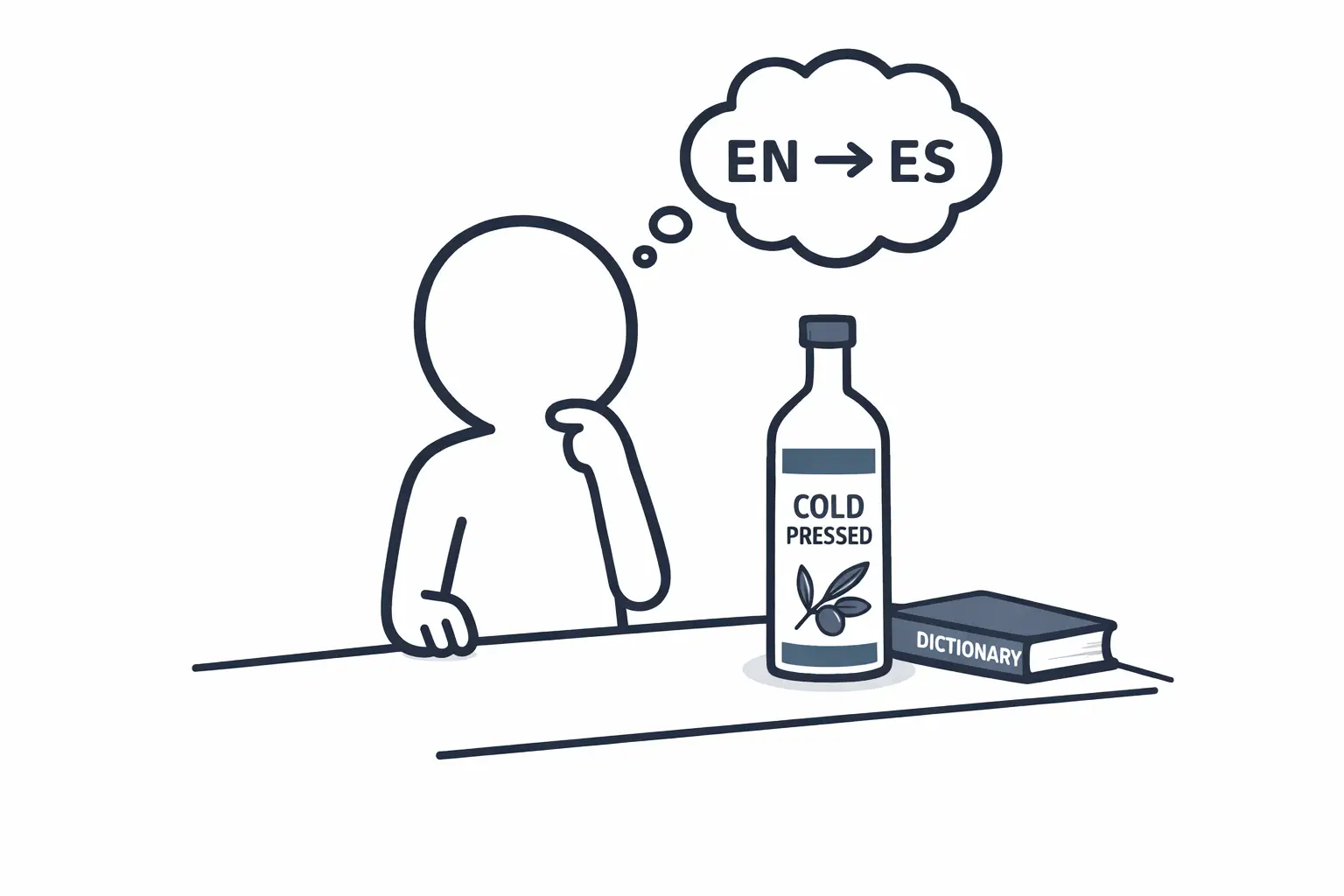
One of the concepts that confused me the most the first time I came across it was "cold pressed" and related expressions: "first cold pressing", "cold extraction", "first press", and so on. It is a term that appears constantly on labels and advertising texts.
In this article, we will look at what cold-pressed olive oil actually means and the translation issues it may cause when translating into English or Spanish.
Olive oil is essentially the natural juice of the olive. Traditionally, to obtain olive oil, olives were literally “crushed”. Examples include the traditional stone mill and the beam press.
However, technology has changed significantly in recent decades.
Today, most olive oil is produced through centrifugation or decantation, a more modern and efficient system. After the olives are first crushed, a centrifuge separates the oil from the water and solid residues according to their density. This allows producers to obtain higher-quality oil in terms of aromas, flavours and beneficial properties. However, a small number of producers still use pressing systems (with mechanical hydraulic presses), although this generally results in lower overall quality.
In short, the term "pressing" should be used when traditional presses are involved, while "extraction" should refer to centrifugal processes.
On the one hand, the temperature at which olive oil is produced is crucial for preserving its positive attributes. The process must take place below 27 °C (80 °F), as higher temperatures can negatively affect aromas and nutritional properties.
On the other hand, for many decades it made sense to talk about first pressing. In the past, oil was obtained through several successive pressings. The first pressing produced the best oil, while each subsequent pressing resulted in lower quality. Nowadays, although the vast majority of olive oils are no longer pressed, these terms are still widely used due to tradition or marketing .
All of this can be quite confusing for consumers.
Strictly speaking, the expression "first cold pressing", for instance, would only be accurate if three conditions are met:
1) The oil is produced using a traditional press.
2) It truly corresponds to the first pressing.
3) The process takes place below 27 °C.
These indications are also regulated by the European legislation on olive oil labelling, which means translators and producers must be careful when using them.
Martín Morillo, I. (2025). Olive oil labeling analysis (Spanish-English) using ATLAS.ti. Transletters. International Journal of Translation and Interpreting, 1(9), 1–22. [Only available in Spanish]
In English-speaking countries such as the United States, the term "pressed" is used very frequently.
At this point, you might be feeling slightly confused. Don’t worry—I felt exactly the same the first time I encountered these terms. So let’s get straight to the point: how should it actually be translated?
As is often the case in translation, the short answer is: it depends.
➜ This is where translation stops being a simple word-for-word substitution and becomes a specialised terminological decision.
To translate these terms correctly, several factors must be considered:
Texts in the agri-food sector are full of technical terminology, regulations and cultural nuances. Translators must take many factors into account: the legal framework in the target country, correct terminology, conventions of the target language and, just as importantly, clarity for the final consumer.
A poor translation in this type of text may not only sound unnatural—it may even fail to comply with labelling regulations.
That is why, when translating complex texts, working with professional specialised translators in the field is essential.
In my work as a translator, these kinds of terminological issues are part of the everyday process: analysing the context, consulting specialised sources and choosing the linguistic solution that works best for the target audience.
Because, when translating, every word matters.
Escuela Superior del Aceite de Oliva (2020). 8 Key Steps for Extra Virgin Olive Oil Extraction.
Have questions, ideas or a project in mind? Get in touch!

